Backfill, compaction, grading, building pads and gravel drives as the finish on our demolition and concrete jobs.
Site preparation in Columbia, MO is the second half of a demolition or concrete job. Once the house is down or the slab is out, the hole gets backfilled in compacted lifts, the lot gets shaped to drain, and the ground gets seeded or graveled so it is finished, not just cleared. We do this work as the finish on our own teardowns and concrete jobs, and on larger stand-alone projects. We don't take small stand-alone grading, drainage ditches or patch jobs.
A house teardown in Columbia leaves a basement hole of 800 to 1,500 square feet, 7 to 9 feet deep. That is 250 to 450 cubic yards of void. Crawlspaces and foundation holes are smaller, but the rule is the same: fill placed wrong settles, and it keeps settling for years.
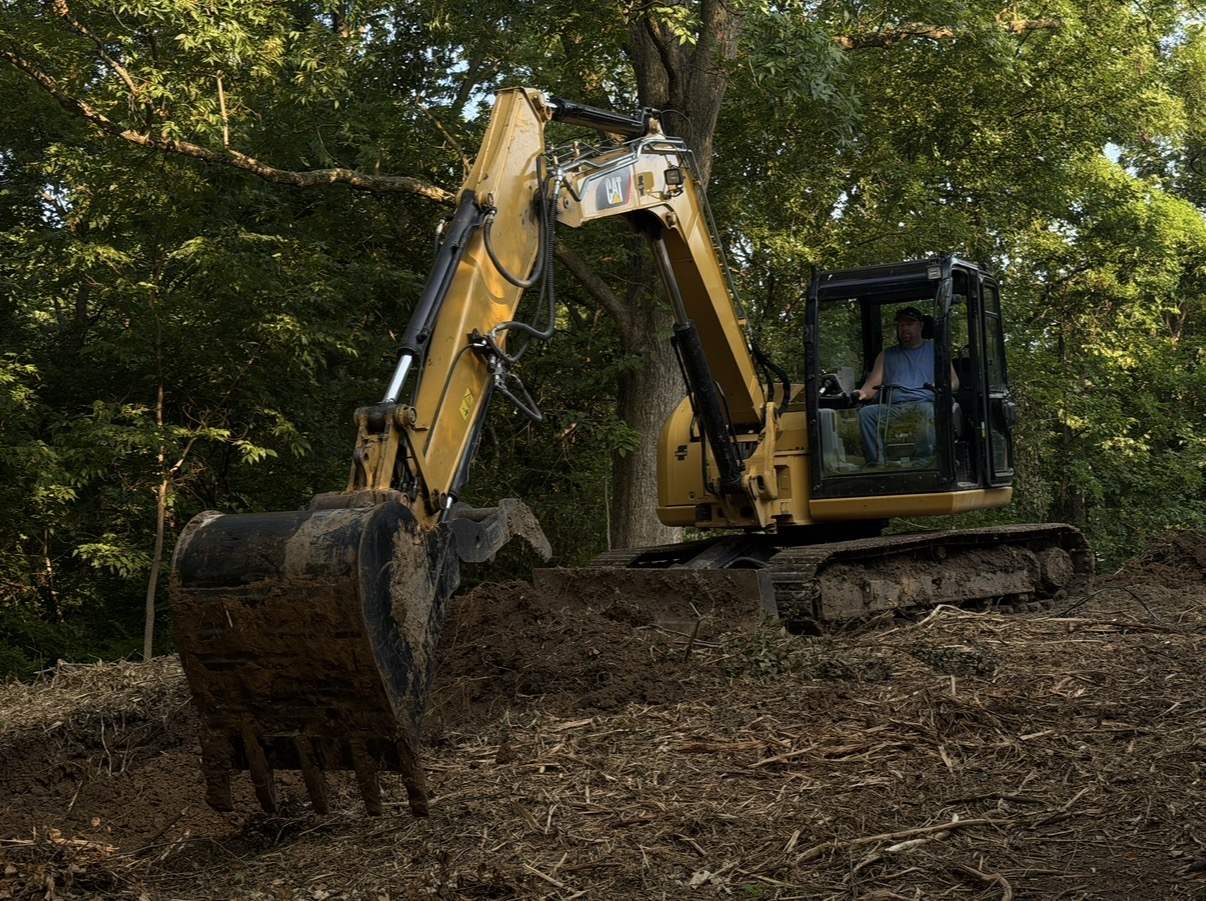
We backfill in lifts of 8 to 12 inches and compact each lift with the excavator and a plate compactor or roller before the next one goes in. Clean broken concrete from the foundation can go in the bottom of the hole where the county allows it. The top 3 to 4 feet is soil so the lot can be graded, seeded and mowed. Cheap fill dumped in one push looks finished the day the crew leaves and shows a sunken rectangle in the yard after the first wet spring. Organics, wood and drywall never go in the hole; they rot, and the ground drops with them.
If the lot will carry a new structure, the fill is compacted to a tighter standard and we tell you what went in and how it was placed.
Rough grade shapes the lot with the excavator and skid steer so water runs away from anything left standing: a neighboring house, a garage, a septic field, the street. We hold a minimum fall of 6 inches in the first 10 feet away from any structure and blend the fill area into the existing yard so there is no bench or lip where the old foundation was.
Final grade is the smooth pass. We pick the large rock and debris, rake the surface, and spread seed and straw when the season allows. On a typical residential lot that is a half day to a day of work at the end of the demolition. What you get is a lot that mows, drains and does not hold water against your neighbor's foundation.
When the teardown is making room for a new home, shop or slab, we build the pad instead of just seeding the lot. That means cutting high ground, filling low ground in compacted lifts, and placing a gravel base so the concrete crew or framer walks onto a pad that is level and holds a loaded truck. Typical pads run 1,200 to 3,000 square feet for a shop or garage and 2,000 to 4,000 square feet for a house footprint plus working room.
If the next step is a new slab, driveway or footing, we carry the project straight through with our concrete and paving crew under the same contract. One proposal, one point of contact, one warranty.
Gravel driveways and parking areas come up often on rural teardowns and on commercial demolition where the owner wants a usable surface without paving. We strip the topsoil, shape the subgrade to drain, place 4 to 6 inches of base rock, cap it with 1-inch clean or minus, and compact it. A 12-foot-wide drive 150 feet long is about 1,800 square feet and 40 to 50 tons of rock. Rock is billed at actual loads because the subgrade decides how much it takes.
Most water problems on a demolition site are grading problems. The old house sat in a low spot, or the slab held water against the neighbor's wall. When we regrade the lot we fix that: swales cut to move water to the street or ditch, low spots filled, downspout areas shaped away from foundations. This is drainage done with the excavator and skid steer as part of the site, not ditch digging or drain tile installation as a stand-alone job.
Every site work quote is a fixed price for mobilization, equipment and crew. Imported fill and rock are billed at actual loads because we do not know how many trucks a hole takes until it is open. Anything hauled off is passed through at actual tonnage, $40 to $90 per ton in Mid-Missouri. When the site work is the tail end of one of our teardowns, most of these numbers are already inside the demolition price. The ranges below are typical; a site visit gives a firm number.
| Work | Typical range |
|---|---|
| Basement backfill and compaction | $2,500 to $8,000 |
| Rough and final grade, seed and straw | $1,500 to $6,000 |
| Building pad prep | $3,000 to $12,000 |
| Gravel drive or lot | $2 to $5 per sq ft |
| Imported fill or rock | Billed at actual loads |
Want a number on a basement fill-in, pad or gravel lot? Get a written bid or call (573) 234-6641. We work in Columbia, Jefferson City, Fulton, Moberly, Fayette, Boonville, Ashland and the rest of Mid-Missouri within about 45 minutes of Columbia.
Yes, on larger projects. If a builder needs a pad cut and compacted for a new shop, a commercial owner wants a gravel lot built, or a property has an open basement hole from someone else's teardown, we will bid it. What we don't take is the small stand-alone job: leveling a low spot in the yard, cutting a ditch, or fixing one drainage problem. Those cost more to mobilize to than they are worth for you or for us. If you are not sure which side of the line your project falls on, call and describe it. We will tell you straight.
Yes. Basement backfill and compaction is part of every structural demolition price we write. Once the foundation walls are broken down or removed, we place fill in 8 to 12 inch lifts and compact each one. Clean concrete from the foundation can go in the bottom where the county allows it, and the top 3 to 4 feet is soil. If you want the lot ready for a new structure instead of a lawn, tell us before we quote so the fill and compaction are done to that standard from the start.
Three things. First, lifts: fill goes in 8 to 12 inches at a time, never in one push. Second, compaction: each lift is worked with the excavator and a plate compactor or roller before the next goes on. Third, clean material: no wood, drywall, roots or trash in the hole, because organics rot and the ground drops with them. A basement filled this way will show minor settlement in the first year, which final grade and a light topdressing take care of. A basement filled with loose material in an afternoon will show a sunken rectangle for a decade.
If that is the plan, yes, but say so up front. A lot graded for lawn and a lot graded for a new house are different jobs. A build-ready pad means tighter compaction, a gravel base, and elevations set to the plan so the footing crew or framer can start without re-grading. We coordinate with your builder on the pad size and finished elevation, and if the next step is a slab or footing our concrete crew can pour it under the same contract.
Yes. Seed and straw is part of final grade on residential teardowns when the season allows. Spring and fall are the windows that take; a lot seeded in July heat or on frozen ground may need a second pass, and we tell you that when we schedule. We spread a standard sun and shade lawn mix and cover with straw to hold moisture and keep the seed in place through the first rain. Sod, landscaping beds and irrigation are not part of the job.
Yes, as part of a demolition or concrete project or as a larger stand-alone job. We strip topsoil, shape the subgrade to drain, place 4 to 6 inches of base rock and cap it with 1-inch clean or minus, then compact. Typical cost is $2 to $5 per square foot depending on subgrade and rock depth, with the rock billed at actual loads. Most rural teardowns get a drive or a parking pad on the way out, and commercial owners often choose gravel over repaving after a parking lot removal.
As part of a regrade, yes. When we grade a lot after a teardown or slab removal we shape it so water moves away from structures and toward the street or ditch, cut swales where the site needs them, and fill the low spots the old building left behind. What we don't do is stand-alone drainage work: digging ditches, installing drain tile or French drains, or fixing a wet basement on a house that is staying. If the water problem is part of a site we are already working, it gets fixed. If it is the whole job, we are not the right call.
Tell us what you need torn out or put back. We'll walk the site and send a written bid.
Get a Written Bid