Full teardowns of houses, garages, barns, sheds and decks, with the foundation out and the lot graded when we leave.
We tear down houses, garages, barns, sheds and decks across Columbia and Mid-Missouri, and we finish the job. The structure comes down, the foundation comes out, the debris is sorted and hauled, the basement is backfilled and compacted, and the lot is graded when we leave. One contractor, one fixed price for the work, disposal billed at cost. Chris Kurtz walks every site, writes the bid and runs the crew.
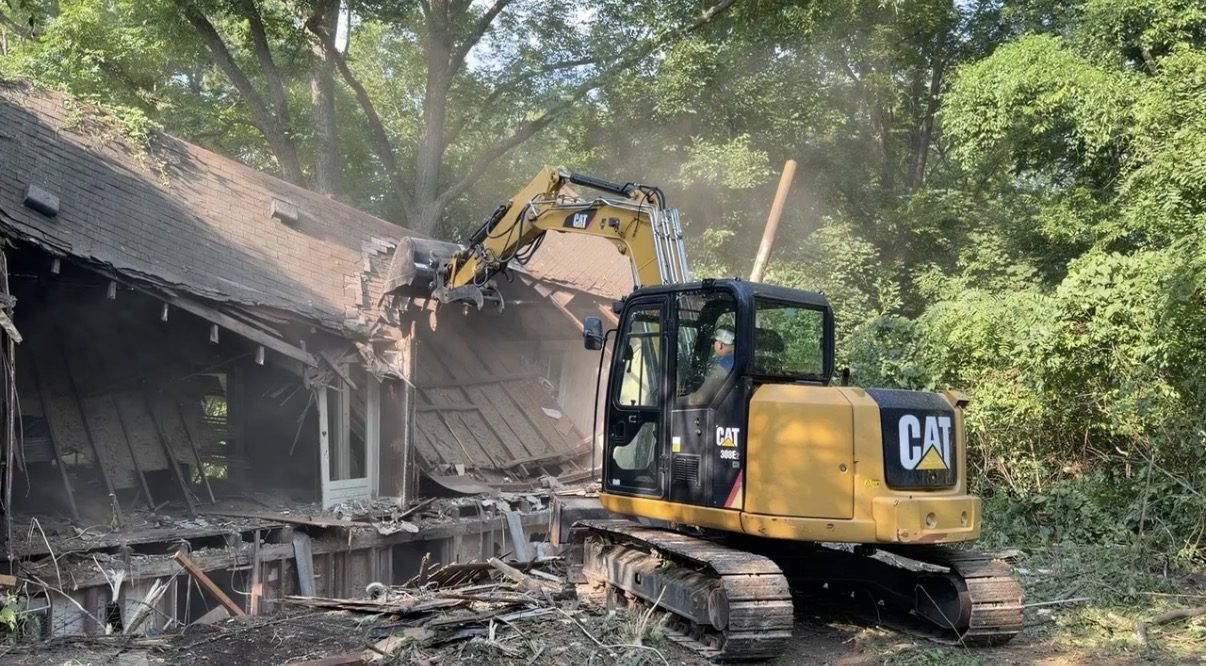
Stick-built houses of any age are the bulk of our demolition work. Most in Columbia are 1,000 to 2,400 square feet on a basement, crawlspace or slab, and most are down in a single day with the Cat 308. Older houses get the asbestos inspection first, because floor tile, pipe wrap and siding from before 1980 are the usual finds. Fire-damaged houses need a look at what is still standing and what the insurance carrier wants documented before anything moves. Condemned structures come with a city or county order that sets the deadline, and we can work to it.
A detached garage is a one-day job: pull the door and any wiring, take the structure down, break out the slab if you want it gone, and haul. An attached garage is selective work. The garage comes off along the shared wall, the house wall gets framed, sheathed and wrapped so it is weathertight, and the slab is broken out or left depending on what goes there next. Attached garages cost more because the hand work at the house wall is measured in hours, not machine time. We check the roof tie-in before the first cut, because a garage roof that shares a ridge or a valley with the house has to come apart in sequence or it pulls shingles and sheathing off the house with it.
Timber-frame barns, pole barns, machine sheds, lean-tos, corn cribs and grain bins. On a barn the salvage decision comes first. Old-growth oak beams and weathered siding are worth money to the right buyer, and we will pull them by hand before the machine touches the rest if the numbers work. Grain bins are cut, flattened and sent to the steel recycler. Concrete floors and footings come out unless you want the pad for something else. Most 30 by 40 barns are down and cleared in two days.
Small structures, fast turnaround. A shed is a half day including the haul. A deck means cutting the ledger free, pulling the framing, digging or breaking the footings, and inspecting the band joist where the ledger bolted through, because every one of those holes was a path for water. We often stack a shed or deck onto a larger job in the same neighborhood to keep the mobilization cost down for you.
This is where a lot of teardowns get left half done. The house is gone, the basement walls are still in the ground, and the hole has been pushed full of broken block and whatever was lying around. That lot will settle for a decade and no builder will want it.
We break out the foundation walls and the floor slab, haul the concrete to a recycler, and backfill with clean fill compacted in lifts. Then we rough grade so the surface sheds water and a mower can cross it. If you are building on the lot, our site work crew can carry straight into excavation for the new foundation, pad prep and finish grade on the same contract. If you are selling or holding, we can seed and straw it.
Asbestos abatement itself is performed by a licensed abatement contractor. We schedule it, hold our start until it clears, and pass the invoice through without markup. Hazardous waste, including fuel oil tanks, propane, chemicals and refrigerant, goes out with the right hauler before we mobilize. Moving personal property is on the owner. Anything still inside on demo day gets crushed with the house and billed by the ton, which is the most expensive way to throw away a couch.
Every bid is two numbers. A fixed price covers mobilization, equipment and crew, and it does not change once the proposal is signed. Disposal is a pass-through at actual loads and tonnage, currently $40 to $90 per ton in Mid-Missouri depending on the material and the facility, and you get every scale ticket. Concrete sorted to a recycler runs at the low end. Mixed household debris runs at the high end.
Typical ranges for the structures we bid around Columbia:
| Structure | Typical range |
|---|---|
| 1,200 sq ft house, no basement | $8,000 to $14,000 |
| 2,000+ sq ft house with basement | $15,000 to $30,000 |
| Detached garage | $3,000 to $6,000 |
| Attached garage | $5,000 to $9,000 |
| Barn, 30 x 40 | $5,000 to $12,000 |
| Larger barns and pole buildings | up to $20,000 |
| Shed | $700 to $2,000 |
| Deck | $800 to $3,000 |
| Disposal (pass-through) | $40 to $90 per ton |
Typical timeline for a house is one to three days on site once the paperwork clears. What moves a job inside those ranges: square footage, a basement versus a slab, whether the machine can reach the building, how much concrete is in the ground, and the distance to the landfill. A two-story house with a full basement in a tight lot with overhead lines is the top of the range. A one-story on a crawlspace with a gravel drive and room to swing is the bottom. A site visit gives a firm number. You can also get a written bid online with photos and the address, and we will follow up with a walkthrough before anything is signed.
We work in Columbia, Jefferson City, Fulton, Moberly, Fayette, Boonville, Ashland and the rest of Mid-Missouri within about 45 minutes of Columbia. Licensed and insured with general liability, umbrella and workers' comp. Call (573) 234-6641 and Chris will set a time to walk the property.
A 1,500 square foot house on a slab or crawlspace typically runs $9,000 to $16,000 in the Columbia area, and $13,000 to $22,000 if it has a full basement to break out and backfill. That is a fixed price for the work plus disposal billed at actual tonnage. A house that size produces roughly 60 to 100 tons of debris, and where the concrete can be recycled the disposal bill drops. Access, a detached garage on the same lot, and distance to the landfill move the number. A site visit gives a firm price.
In almost every case, yes. Missouri DNR requires an asbestos inspection before demolition of most structures under the federal NESHAP rule, regardless of the age of the building. An accredited inspector samples floor tile, mastic, pipe insulation, siding, drywall compound and roofing. If regulated material is found, a licensed abatement contractor removes it and DNR gets a 10-working-day notice before demolition. We schedule the inspection, coordinate the abatement, and hold our start date until the clearance is in hand.
Yes, if it is worth saving. On a slab-on-grade house where the new building will match the footprint, an engineer can evaluate the slab and we will demolish the structure down to it and sweep it clean. On a basement house, keeping the walls only makes sense if a new house is going on the same foundation right away and an engineer signs off. Otherwise an open basement is a liability and a settling problem. Most of the time the foundation comes out and the hole gets properly backfilled.
We break out the basement walls and the floor slab, haul the concrete to a recycler, and backfill the hole with clean fill placed and compacted in lifts of about a foot. Then we rough grade the surface so it drains. Compaction is the part that matters. A basement filled loose will settle for years and any slab, driveway or house built over it will crack. If you plan to build on the lot, tell us at the site visit and we will compact to a spec a builder can use.
On site, one to three days for a typical house. The building is down in a day, and sorting, loading, hauling and breaking out the foundation take one or two more. Garages, sheds and decks are usually a single day. The calendar before the machine arrives is longer: asbestos inspection, any abatement, utility disconnects and permit review commonly run two to four weeks. Plan on three to six weeks from first call to a graded lot, with the machine time being the short part.
Yes in both cases, but from different offices. Inside Columbia, City of Columbia Building and Site Development issues the demolition permit and will want the asbestos inspection and utility disconnect confirmations with the application. Outside the city in Boone County, Boone County Resource Management issues it, with lighter requirements on some rural structures. Neighboring counties have their own process. We pull the permit under our name on every job and the fee is in our price, so you do not have to sort out which office wants what.
Yes. Both get dealt with before the teardown. The well is capped according to Missouri DNR well abandonment rules, either by us or by a licensed well driller depending on the construction, and we coordinate that. The septic tank is pumped by a licensed hauler, then crushed and backfilled or capped in place depending on county requirements. If you plan to build again and reuse either one, tell us at the site visit and we will protect them and work around them instead.
Yes to both. Fire-damaged structures are a regular part of our work. We document the site with photos before anything moves, write a proposal that itemizes the demolition, disposal and backfill the way an adjuster expects to see it, and coordinate directly with the carrier if you want us to. Fire debris often weighs more than people expect because of water in the material, and it usually goes to the landfill rather than a recycler, so the disposal line runs higher. We tell you that up front.
Tell us what you need torn out or put back. We'll walk the site and send a written bid.
Get a Written Bid