About 35 minutes northwest of Columbia. Farmhouse, barn and mobile home teardowns plus concrete removal across Howard County.
Fayette is the Howard County seat, home to Central Methodist University, and about 35 minutes northwest of Columbia by way of I-70 and Highway 240 or up through Harrisburg on Route 124. It is a small town surrounded by a lot of farm ground, and the work we do there reflects that. We are in Howard County regularly, mostly for farm buildings, older houses and mobile homes rather than commercial lots.
Atlas Demolition & Site Work is run by its owner. Chris Kurtz walks the property, writes the proposal and operates the equipment. We are licensed and insured: general liability, umbrella and workers' comp. Call (573) 234-6641 or get a written bid online.
In Fayette itself, the housing around the courthouse square and the college is old, much of it from the 1880s through the 1920s, with the same brick foundations and layered roofs as the rest of Mid-Missouri's county-seat towns. But the majority of calls from Howard County are about what is out on the farm: a barn that lost its roof in the last windstorm, a hog house nobody has used since the 1990s, a farmhouse the family moved out of a generation ago, or a mobile home that was set next to it and is now past saving.
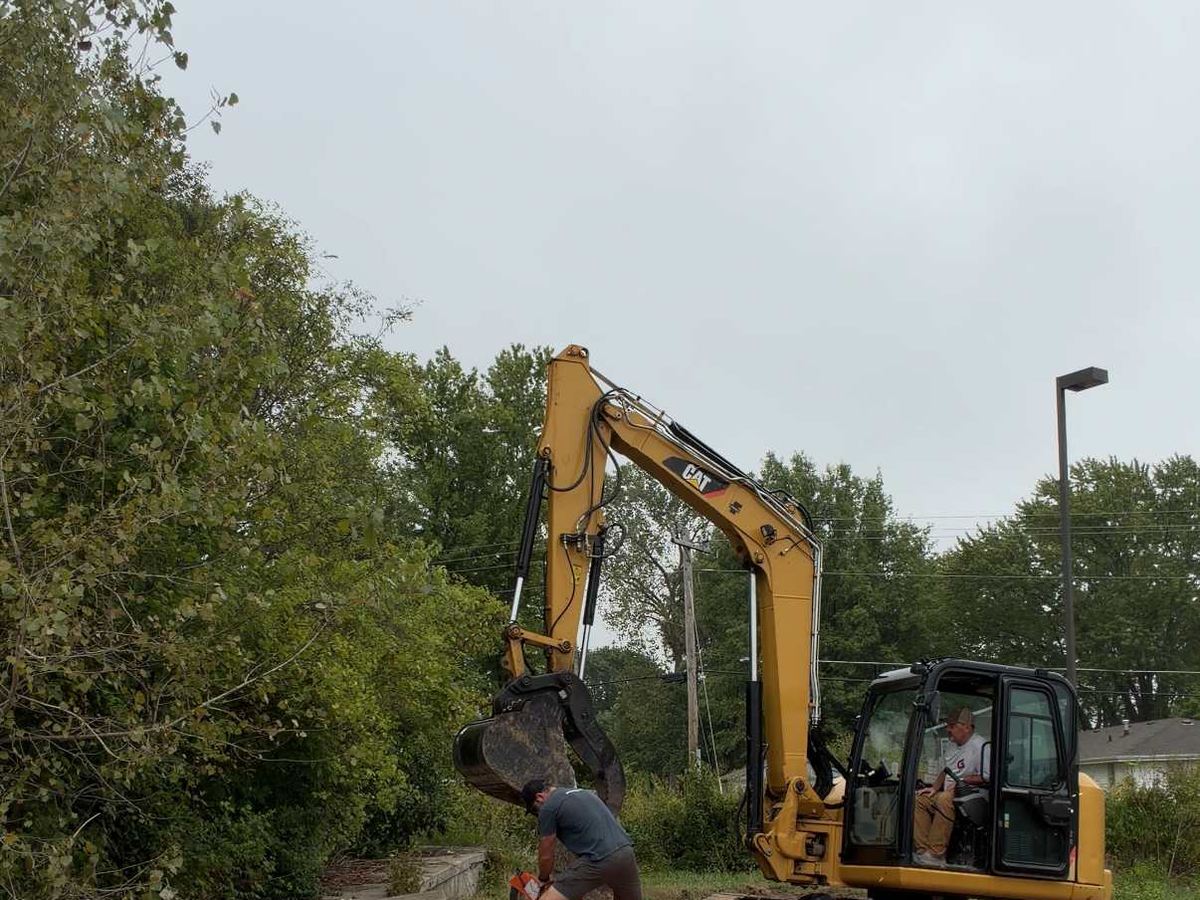
A standard timber-frame barn, 36 by 60 or so, is typically a one-day teardown and 20 to 40 tons once the steel roofing is pulled out for scrap. Concrete floors under it add a half day and the bulk of the tonnage. The demolition page has the full list, and the barn demolition guide covers what to expect on farm sites.
Concrete work in Howard County is mostly residential and agricultural. Driveway replacement for houses in town and long farm drives with a concrete apron at the road. Feed-lot slabs, dairy floors, silo pads and grain-bin footings that need to come out before the ground goes back to crop or pasture. Old house foundations that have been sitting in a field for decades. All of it falls under concrete removal: break it, load it, haul it, grade the hole.
There is some parking lot removal in Fayette too, mainly churches, the school district and small businesses near the square, and the process is the same as anywhere else. We do not do concrete leveling or patch repair.
Farm concrete tends to be thicker and dirtier than town concrete. A feed-lot slab has manure and soil worked into it, which affects where it can be recycled and what disposal costs. We look at that on the site visit rather than guess.
Inside Fayette city limits, the City of Fayette handles demolition permits through city hall. Outside the city, in the unincorporated county and around Glasgow, New Franklin and Armstrong, check with the county planning office in Fayette; permit requirements in rural Howard County are limited, but they are not zero, and it is a five-minute call to confirm.
The Missouri Department of Natural Resources asbestos inspection requirement applies statewide and does not care whether the building is a house in town or a barn in a field. Most structures need an inspection before demolition. Old farmhouses and mobile homes commonly turn up regulated material; open timber barns often do not, but the inspection is still required. Where material is found, a licensed abatement contractor removes it and DNR gets a 10-working-day notification. We coordinate the inspection, the abatement and the disconnects (co-op electric, propane, well or water, septic). We do not perform abatement.
We bid a fixed price for mobilization, equipment and crew. Disposal is billed as a pass-through at actual loads and tonnage, $40 to $90 per ton in Mid-Missouri, and scrap steel from barns and mobile homes is credited against it where it applies. Mobilization to Howard County is inside the fixed price. A Fayette job needs to be worth the drive: a barn, a farmhouse or a mobile home clears that bar easily, a single small slab on its own usually does not, and combining two or three small jobs on one property into a single trip is the way to make the numbers work. A site visit gives you a firm number.
Farm sites also come with things a town lot does not: fence lines to open up, soft ground after a wet spring, and livestock on the next pasture over. We plan the machine route in and out on the site visit, and if the ground is too soft to haul across without rutting a field, we say so and schedule around it.
From Fayette we also work in Glasgow, New Franklin, Armstrong and the rural parts of Howard County toward Harrisburg.
There is no travel surcharge. Mobilization is part of the fixed price. Distance shows up in a different way: a small job in Howard County costs more per square foot than the same job in Columbia, because the trip is the same either way. A barn, a house or a mobile home removal is not affected. If you have several small things on one property, bundling them into one trip keeps the price sensible.
Inside city limits, the City of Fayette through city hall. Outside the city, the county planning office in Fayette. Rural Howard County has limited permit requirements for farm buildings, but the Missouri DNR asbestos inspection is a state rule and applies everywhere. We confirm the local requirement on every job rather than assume.
Under Missouri DNR rules, most structures do, and that includes barns. Open timber barns rarely contain regulated material, but older ones with tar-paper roofing, transite siding or an attached milk house often do, and the inspection is what settles it. It is a quick visit from a licensed inspector, and we schedule it as part of the job.
Yes. Grain bins are cut and dropped in sections and the steel goes to scrap, which usually covers a good part of the disposal. Concrete stave silos come down with the excavator and thumb from the top, working around the site. Either way, the concrete pad and footings come out if you want the ground returned to crop or pasture.
Regularly. Older single-wides and double-wides on farm parcels are a common Howard County job. We break the unit down on site, scrap the frame and axles, haul the rest, pull the piers and any slab, and grade the pad. Asbestos inspection applies to older units. Most single-wides are done in a day.
Tell us what you need torn out or put back. We'll walk the site and send a written bid.
Get a Written Bid