Old drive out, base rebuilt, new reinforced slab poured. Two working days on site, seven days to cure, one contract.
We replace concrete driveways in Columbia, MO from tear-out to broom finish. Our crew saw-cuts the old drive loose at the garage and the sidewalk, breaks it with a Cat 308 and hydraulic breaker, hauls it to a crusher and builds a compacted rock base. Then our concrete crew forms, reinforces and pours the new slab under our contract and our warranty. Two working days on site for most two-car drives, seven days before you park on it. One contractor, one number to call.
A driveway is worth replacing when the problem is in the slab or under it, not on top of it. Four things that point to tear-out instead of another year of patching:
Hairline cracks, one settled panel or surface staining are not reasons to replace. A leveling or sealing company is the right call for those, and we will tell you so at the site visit. We don't do concrete leveling or patch repair.
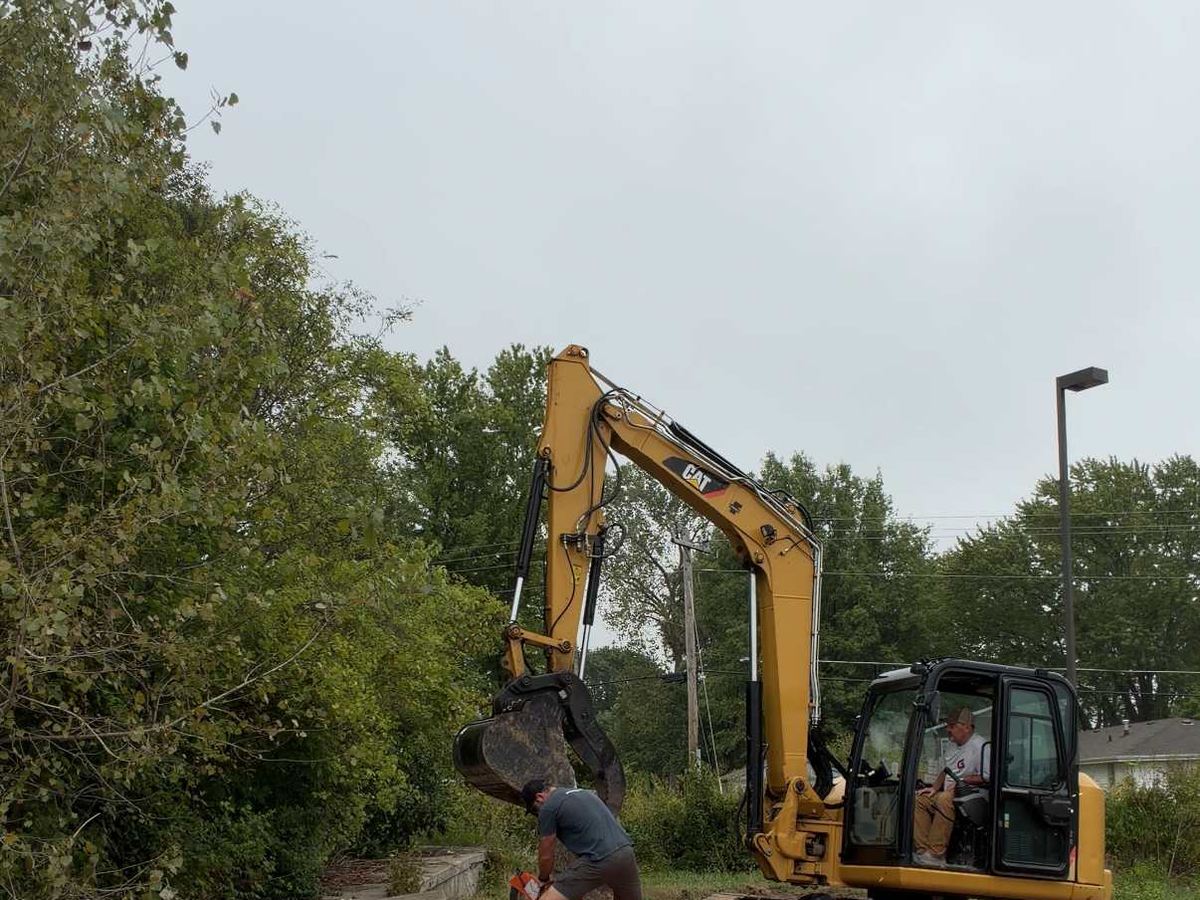
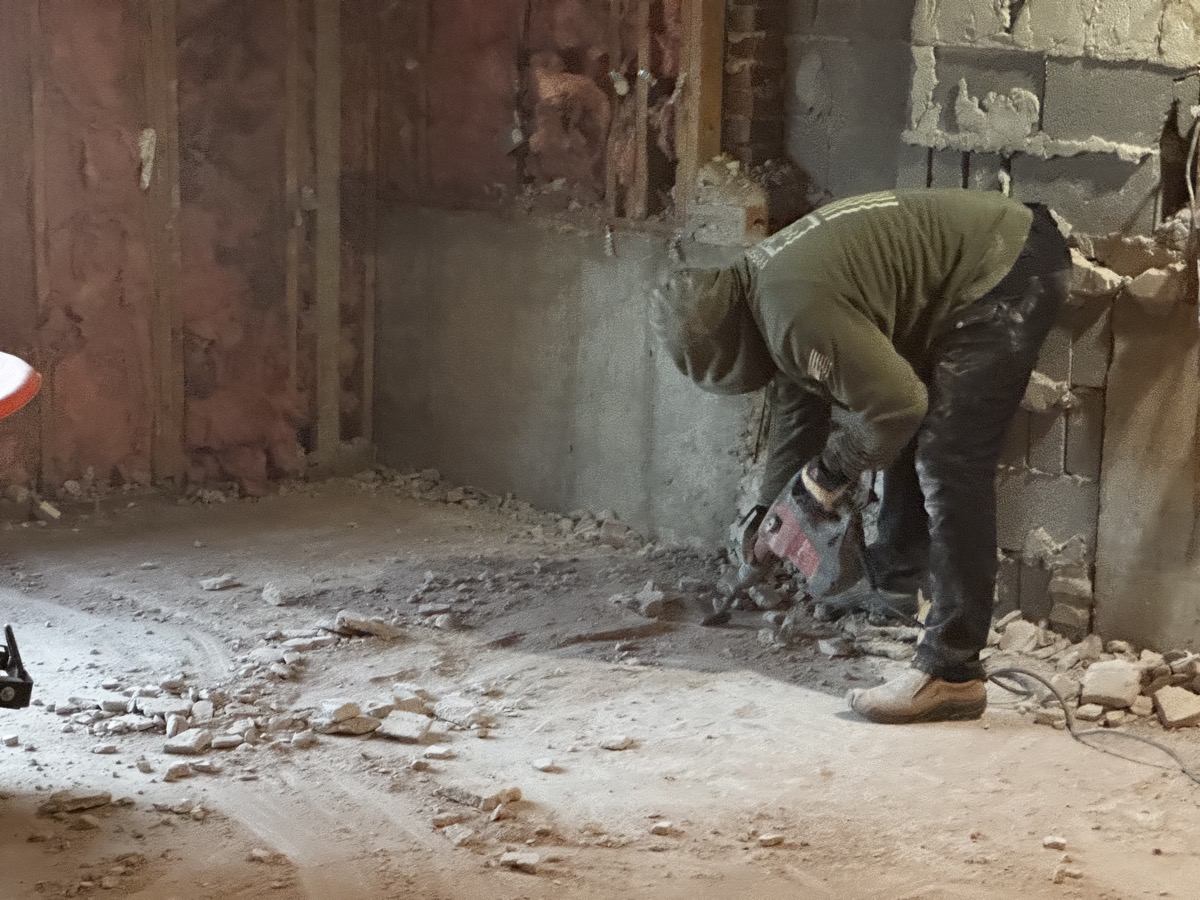
We saw-cut a clean line at the garage apron and where the drive meets the public sidewalk or street so the concrete that stays keeps a straight, undamaged edge. The old slab comes out with the breaker on the Cat 308 and goes straight into trucks. Rebar and wire mesh are pulled and scrapped. A 700 sq ft, 4-inch drive is about 17 tons of concrete. A 6-inch drive with rebar is closer to 26. All of it goes to a crusher in the Columbia area and comes back as base rock, not to a landfill.
This is the part most failed driveways never had. Mid-Missouri sits on clay that swells wet and shrinks dry, and a slab poured straight on it rides that movement until it cracks. We cut the subgrade to depth, compact it, then place 4 inches of crushed limestone base and compact that in lifts. The base spreads the load, drains, and gives the slab a stable platform. Where the old drive settled badly, we go deeper and replace the soft clay with more rock.
Residential standard is a 4-inch slab, 4,000 psi air-entrained mix for freeze-thaw, reinforced with fiber in the mix or #3 rebar on a 24-inch grid. Your call at the proposal; rebar costs more and holds a cracked panel together better. Drives that carry an RV, a boat trailer or a loaded work truck get 5 to 6 inches with rebar. Control joints are cut every 10 to 12 feet so the shrinkage cracks land in the joints instead of across a panel. Broom finish for traction. Foot traffic after 24 hours, vehicles after 7 days, full design strength at 28.
Adding a third stall, widening a 10-foot drive to 12 or 16, or pouring a turnaround pad is the same work at a smaller scale. New concrete is doweled into the existing slab or separated with an isolation joint, depending on the age and condition of what is there. If the existing drive is sound, we do the extension alone at new-concrete pricing. If you are replacing anyway, widening at the same time costs only the extra square footage.
Long rural drives outside Columbia are the usual case. Gravel that has been driven on for years is often a decent base already. We strip the loose stone and mud, regrade for drainage, add fresh rock where the old base is thin, compact and pour. Length is the cost driver: a 12-foot-wide drive is 1,200 sq ft per 100 feet. Many owners concrete the first 40 to 60 feet at the road and the pad at the garage, and keep gravel in between.
The apron between the sidewalk and the street is in the public right-of-way. Inside Columbia city limits, replacing it takes a right-of-way permit from the City of Columbia, and the new apron and any sidewalk panels across the drive have to be poured to city standards, generally 6 inches thick with the curb cut rebuilt. We pull the permit and pour to spec so the inspection passes the first time. Outside city limits, Boone County and MoDOT (on state routes) have their own approach requirements, and we handle those the same way.
Fixed price for mobilization, equipment and crew. Disposal is billed as a pass-through at actual loads and tonnage. Typical ranges for Mid-Missouri:
| Item | Typical range |
|---|---|
| Removal of the old drive | $3–$7 per sq ft |
| New 4-inch reinforced concrete | $8–$12 per sq ft |
| New 5- to 6-inch reinforced concrete | $10–$14 per sq ft |
| Two-car drive, 600–800 sq ft, removed and replaced | $7,000–$14,000 |
| Larger or longer drives | $15,000–$30,000 |
| Disposal (pass-through) | $40–$90 per ton |
| Timeline | Day 1 removal and base, day 2 pour, 7-day cure before driving |
Thickness, rebar versus fiber, how deep the base has to go, whether a truck can back up to the drive, and whether the apron is in the right-of-way move the number inside those ranges. A site visit gives a firm number. To start, get a written bid from photos and dimensions.
Licensed and insured, with general liability, umbrella and workers' comp. We work Columbia, Jefferson City, Fulton, Moberly, Fayette, Boonville, Ashland and the rest of Mid-Missouri within about 45 minutes of Columbia. Call (573) 234-6641.
A typical two-car drive of 600 to 800 sq ft runs $7,000 to $14,000 removed and replaced. That is $3 to $7 per square foot to tear out the old slab plus $8 to $12 per square foot for a new 4-inch reinforced pour, with disposal passed through at $40 to $90 per ton. Longer rural drives and 6-inch slabs land between $15,000 and $30,000. A site visit gives a firm number.
Walk on it after 24 hours. Park a car or pickup on it after 7 days. Keep RVs, loaded trailers and delivery trucks off it for 28 days, which is when the mix reaches full design strength. Hot weather speeds the early set but not the strength gain, and cold weather slows both, so in November we may ask for an extra few days. We put the dates in writing so you can plan where to park.
One contractor. We self-perform the removal with the Cat 308 and hydraulic breaker, build the base, and our concrete crew forms and pours the new slab under our contract and our warranty. You sign one proposal and get one invoice. If a panel cracks or a joint fails, you call us and we deal with it. There is no gap between the demo company and the flatwork company where the base work gets lost.
Four inches, reinforced, is the residential standard for cars and pickups. Go to 5 or 6 inches with rebar if the drive carries an RV, a boat trailer, a dump truck or a loaded work truck on a regular basis. The apron in the Columbia right-of-way is 6 inches to city standard regardless. Thickness is cheap compared to tear-out: going from 4 to 6 inches adds about $2 per square foot, or $1,400 on a 700 sq ft drive.
Yes. We pour extensions for a third stall, a wider approach or a turnaround pad. The new section is doweled into the existing slab or separated with an isolation joint depending on the condition of what is there. If the existing drive is sound we do the extension alone at new-concrete pricing, $8 to $12 per square foot. If you are replacing the drive anyway, widening at the same time costs only the added square footage.
Inside Columbia city limits, yes. The apron and any sidewalk panels across the drive sit in the public right-of-way, and replacing them takes a right-of-way permit from the City of Columbia with the pour done to city standards. We pull the permit and pour to spec. The private portion of a residential drive generally does not need a building permit. Outside the city, Boone County and MoDOT on state routes have their own approach rules, and we handle those too.
We fix it in the base, not the surface. The subgrade and rock are graded to fall a quarter inch per foot away from the garage, and the slab follows that grade. Where the lot forces water toward the house, a trench drain at the garage door tied to daylight or a storm line catches it. This is the main reason a drive that pitches the wrong way should be replaced rather than leveled; leveling lifts the slab but cannot change which direction it sheds water.
Yes. Asphalt runs $4 to $8 per square foot and makes sense on long rural drives where concrete would be a $30,000 project. It needs seal coating every three to five years and does not hold an edge as well as concrete. Most drives inside Columbia go back as concrete. We remove either material, and we will price both on a long drive so you can compare the up-front cost against the maintenance.
Tell us what you need torn out or put back. We'll walk the site and send a written bid.
Get a Written Bid