Strip-outs, gut-outs and selective structural work for owners, property managers and GCs, with the building around it protected.
We strip commercial suites and gut residential interiors back to the shell, and we take out the porches, additions and chimneys a remodel needs gone. Property owners, property managers and general contractors in Columbia, MO hire us when a space has to be empty, clean and ready for the next trade on a date. Chris Kurtz bids the work in person and runs it. This page covers scope, protecting what stays, debris, pricing per square foot and how we sequence a job.
A strip-out takes a space back to shell. Structure, slab, roof deck and exterior walls stay. Everything the last tenant or owner put in comes out:
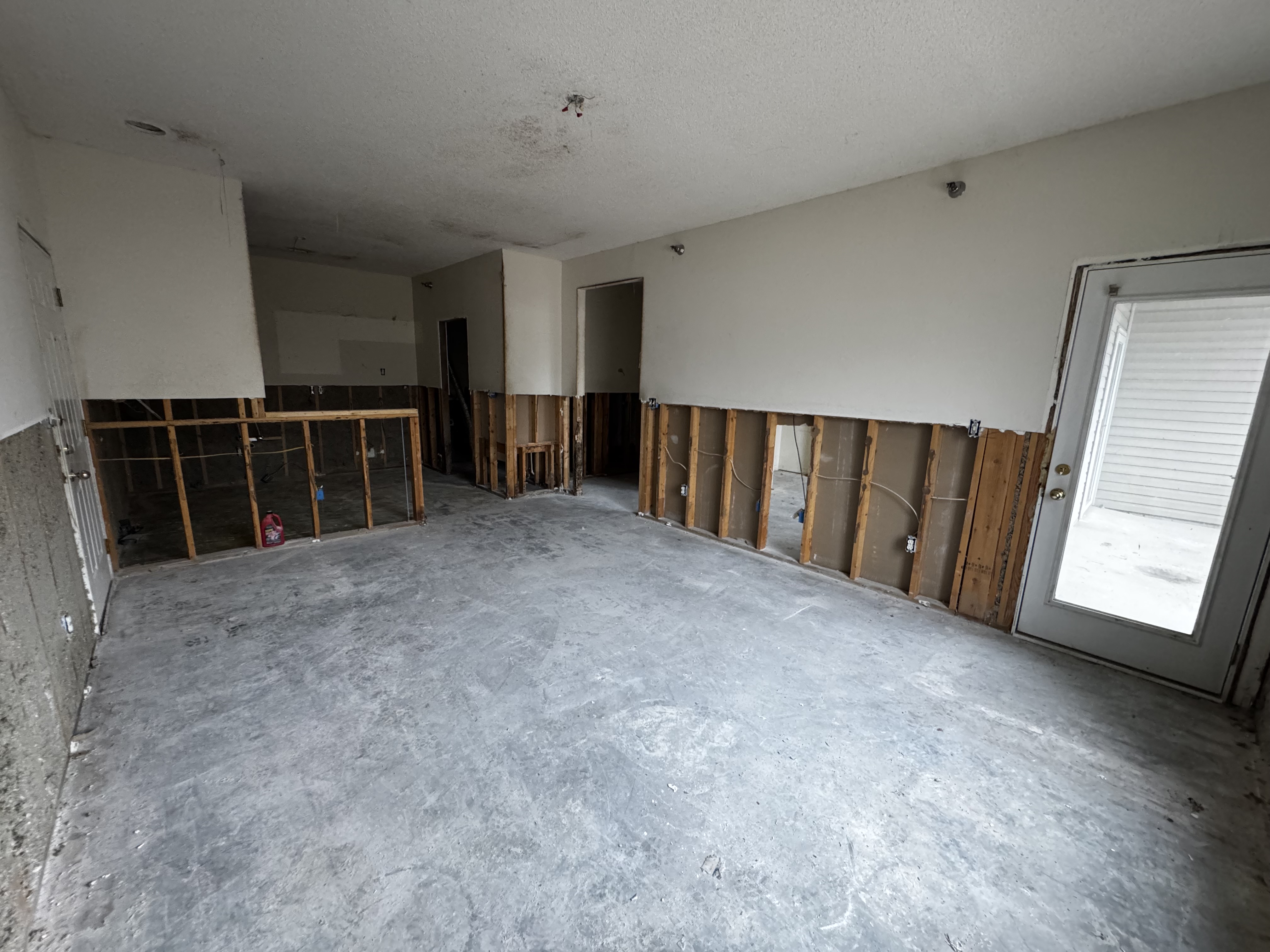
On the residential side the same work is a whole-house gut: plaster or drywall, ceilings, flooring, kitchens, baths and old mechanical runs down to studs and joists so the remodeler starts from framing. A white-box turnover for a commercial landlord is a strip-out plus a clean, empty condition the next tenant's GC can start from. Our post on commercial strip-out demolition in Columbia goes deeper on scope and the asbestos clock.
Selective demolition is the middle case: part of the building comes down and the rest stays occupied and in use. Common jobs:
If a wall is load-bearing, an engineer's letter comes first and the shoring is in the scope before we cut. We do the demolition and the temporary shoring; the new beam is the framer's. Our post on partial demolition in Columbia, MO covers how we separate what leaves from what stays.
The value on a selective job is in what does not get damaged. Standard protection on our jobs:
On occupied commercial work the plan gets written before day one: haul route, elevator pads, hours, who to call when a tenant complains. Property managers get it in writing with the proposal.
Debris does not sit. On a strip-out we run dumpsters on a haul cycle so the work area is clear at the end of each shift: a 30-yard box turns every day or two on a 2,000 to 5,000 square foot suite, and the swaps are scheduled so the lot or dock is not blocked during business hours. Where a dumpster will not fit, we load a dump trailer and haul in cycles.
Metal is separated and scrapped: studs, conduit, duct, fixtures and appliances. Clean concrete and block go to a recycler where one is in range. Both keep tonnage off the landfill ticket, which is where your disposal cost lives.
Fixed price for mobilization, equipment and crew, scoped from a walkthrough. Disposal is a pass-through at actual loads and tonnage, $40 to $90 per ton in Mid-Missouri. Metal scrap is credited back. Per-square-foot figures are how bids get compared, but the real drivers are what the finishes are made of, how many stories up the space sits and how much protection the building needs.
| Scope | Typical range | Timeline |
|---|---|---|
| Residential interior gut | $2 – $6 per sq ft | 1,500 sq ft house: 3–5 days |
| Commercial strip-out / tenant improvement demo | $3 – $10 per sq ft | 2,000 sq ft suite: 2–4 days |
| Selective structural (porch, addition, chimney) | $900 – $7,000 | 1–3 days |
| Disposal (pass-through) | $40 – $90 per ton | Billed at actual weight |
Those are typical ranges. A walkthrough gives you a firm number, and on a GC bid we return a written scope you can drop straight into your sub list. Get a written bid or call (573) 234-6641.
We sub for GCs on tenant finish, remodels and white-box turnovers in Columbia, Jefferson City, Fulton, Moberly, Fayette, Boonville, Ashland and the rest of Mid-Missouri within about 45 minutes of Columbia. Licensed and insured with general liability, umbrella and workers' comp, and we can provide certificates naming the owner and the GC. Send the drawings and a date and you get back a flat written scope.
Residential interior guts run $2 to $6 per square foot. Commercial strip-outs and tenant improvement demo run $3 to $10 per square foot, with open office at the low end and restaurants and medical suites at the top. Both figures cover labor, equipment, protection and hauling at a fixed price; disposal is billed as a pass-through at $40 to $90 per ton. Selective structural items like a porch, addition or chimney are priced as a line item, typically $900 to $7,000. A walkthrough gives you a firm number.
Yes, and most of our commercial work is in occupied buildings. We phase the space so tenants keep their egress, put up dust walls with negative air where the building calls for it, protect the haul route with ram board or plywood, and schedule loud work and dumpster swaps for evenings or weekends by arrangement with the property manager. The hours, haul route and a contact for complaints are written into the proposal before day one.
We coordinate it; we do not perform abatement. Missouri DNR requires an asbestos inspection before demolition of most structures, and a strip-out counts when it disturbs floor tile, mastic, plaster, pipe insulation or ceiling material. We schedule the inspector at the start. If regulated material is found, a licensed abatement contractor removes it and the state gets a 10-working-day notice before that starts. Build that into the schedule early, because it is the one item that can move a two-week job to five.
Yes, with an engineer's letter and temporary shoring in the scope. On a selective structural job the engineer specifies what carries the load and how it is supported while the wall is out. We install the shoring, remove the wall and leave the opening ready for the framer to set the new beam or header. Bearing walls are priced as their own line item, separate from the per-square-foot interior work, because the shoring and sequencing are different.
Dust walls between the work area and occupied space: poly with zipper doors on short jobs, temporary framed and drywalled barriers on longer ones. Negative air machines pull the work area below the pressure of the rest of the building so dust moves toward the filter, not the hallway. Floors on the haul route get ram board or plywood, and HVAC returns in the work area are sealed so the building's air handler is not pulling debris. Debris leaves daily so it is not sitting in the space.
Yes. We sub interior demolition, strip-outs and selective structural work for GCs on tenant finish, remodels and white-box turnovers across Mid-Missouri. Send drawings and a date and you get back a flat written scope with protection, hours and disposal as pass-through. We are licensed and insured with general liability, umbrella and workers' comp, and we provide certificates naming the owner and the GC. Chris runs the crew himself, so the person who bid the job is the one on site.
Usually one to two weeks from a signed proposal for a job with no asbestos issues, depending on the schedule. The walkthrough and written proposal come first, typically within a day or two. The items that set the start date are outside our control: the DNR asbestos inspection, the licensed trades making MEP safe, and the permit if one is required. Call early, get the inspection scheduled, and the demo itself is 2 to 4 days on a 2,000 square foot suite.
Tell us what you need torn out or put back. We'll walk the site and send a written bid.
Get a Written Bid