About 35 minutes down Highway 63 from our yard in Columbia. Teardowns, commercial strip-outs and concrete removal in Cole County.
Jefferson City is the state capital, the Cole County seat, and about 35 minutes south of our yard in Columbia on Highway 63. We work there regularly. It is the second-largest market in our service area and the one with the most commercial and institutional property, which means more strip-outs, more parking lots and more older masonry buildings than anywhere else we go.
Atlas Demolition & Site Work is owner-operated. Chris Kurtz bids every job in person, and he is on site running the work, not sending a crew he has never met. Licensed and insured: general liability, umbrella and workers' comp. Reach us at (573) 234-6641 or get a written bid from the site.
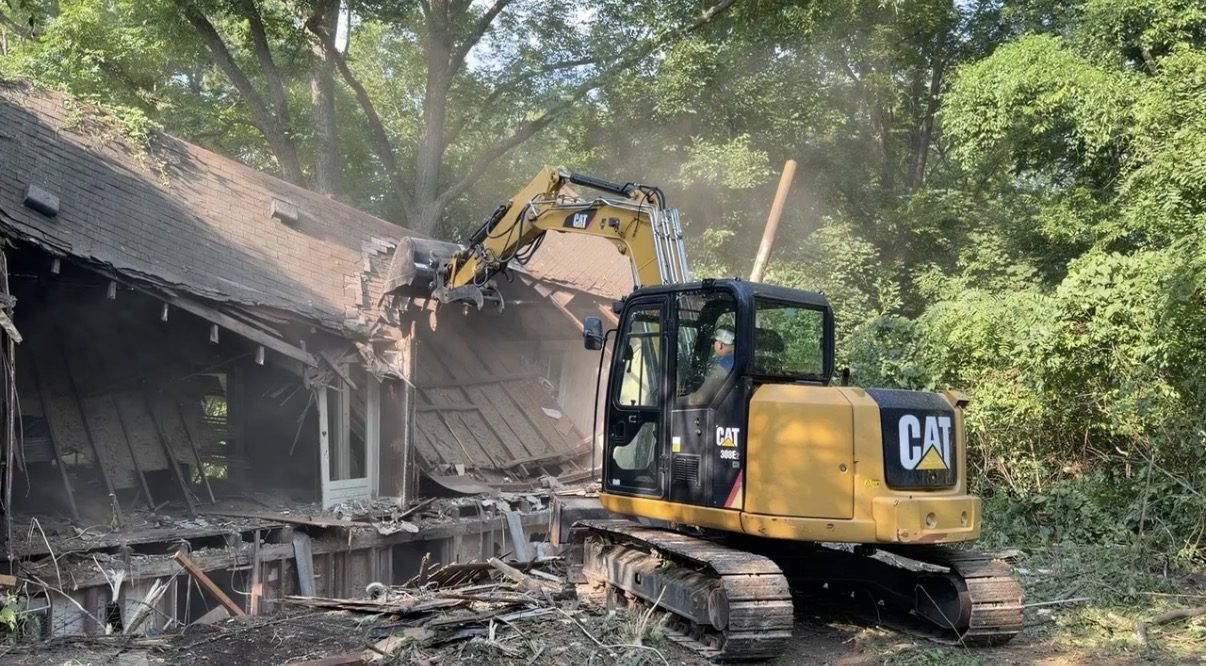
The building stock in Jefferson City runs old. The neighborhoods that climb the hills off the river have brick and stone houses from the late 1800s, the kind with 18-inch rubble foundations and three layers of roofing. The areas that grew with state government in the mid-1900s are full of small frame and brick ranches. Both come down fine; they just weigh more per square foot than a modern house, and the disposal line reflects it.
Because the capital brings a steady stream of office and institutional remodels, interior demolition is a bigger share of our Jefferson City work than it is anywhere else in Mid-Missouri.
What we handle in Cole County:
Old brick houses in Jefferson City tend to run heavy: a 1,500-square-foot two-story with a stone foundation can produce 150 tons or more of masonry and lumber. Brick and clean concrete can often be recycled at a lower rate than mixed debris, which is one reason we sort loads on site. More on the demolition page.
Commercial concrete is where Jefferson City keeps us busiest. State office buildings, churches, medical offices, car dealers and strip retail along Missouri Boulevard all have lots that were poured decades ago and are now cracked, heaved and holding water. Parking lot removal means breaking out the slab or asphalt, hauling it, regrading and compacting the base, and either handing the lot to your paver or having our concrete crew pour the replacement under our contract.
On the residential side, driveway replacement on the older hillside lots often means removing a drive that was poured in two or three sections over fifty years, none of them at the same grade. Retaining walls, patios, garage slabs and old foundations fall under concrete removal. We do not do concrete leveling or patch repair; when a slab is done, it comes out.
The concrete removal cost guide covers the per-square-foot numbers, which hold for Jefferson City with a modest adjustment for haul distance.
Access matters more in Jefferson City than most towns. The hillside streets are narrow, some lots are only reachable from an alley, and downtown work has to respect state and city traffic. We plan truck routing and staging on the site visit and, when a lot backs up to a public street, we handle the lane closure paperwork with the city.
Inside Jefferson City limits, demolition permits go through the City of Jefferson's Planning and Protective Services department, which houses building regulations. Outside the city, in the unincorporated county or the small towns without their own building office, Cole County Public Works and Planning is the contact. Neither will issue a permit without documented utility disconnects.
The Missouri Department of Natural Resources requires an asbestos inspection before most demolitions, statewide, and Jefferson City's older buildings almost always turn up something: pipe insulation, floor tile, plaster, siding. If regulated material is found, a licensed abatement contractor removes it and DNR gets a 10-working-day notification before we start. We coordinate the inspection, the abatement and the electric, gas, water and sewer disconnects. We do not perform abatement.
Fixed price for mobilization, equipment and crew. Disposal billed as a pass-through at actual loads and tonnage, currently $40 to $90 per ton in Mid-Missouri. Mobilization to Jefferson City is inside the fixed price, but a Jefferson City job needs to be worth the drive. A full teardown or a parking lot absorbs the trip without any real change in unit price. A single small patio removal does not, and we will tell you that up front rather than pad the number. A site visit gets you a firm figure.
Around Jefferson City we also work in Holts Summit, Wardsville, Taos and St. Martins, plus the river-bottom and rural parcels across Cole County.
There is no separate travel line on the bid. Mobilization is part of the fixed price. What changes with distance is the per-square-foot cost on small jobs: a half-day patio removal in Jefferson City carries the same trip as a three-day teardown, so it costs more per square foot. Large jobs are not affected in any meaningful way. We will tell you if a job is too small to make sense from Columbia.
The City of Jefferson's Planning and Protective Services department handles demolition permits inside city limits. Outside the city, Cole County Public Works and Planning is the office to call. Both require proof of utility disconnects, and for most buildings a Missouri DNR asbestos inspection report before the permit is issued.
Yes. Office, retail and medical strip-outs are a regular part of our Jefferson City work. We take the space back to shell: partitions, ceilings, flooring, casework, fixtures and MEP rough-ins that the remodel does not reuse. We stage dumpsters and work hours around tenants in the rest of the building and coordinate with the general contractor's schedule.
Slower and heavier than a frame house. Brick walls come down in sections with the excavator thumb rather than being pushed over, and the stone foundations take a hydraulic breaker. We sort the brick and clean concrete separately from the framing because it often recycles at a lower rate than mixed debris. Expect 100 to 200 tons for a two-story masonry house.
Either. Some owners have a paving contractor already lined up and just need the old lot out and the base regraded. Others want one contract for the whole job. In that case our concrete crew pours the new lot under our contract and warranty, and asphalt replacement is available as well. The proposal separates removal from replacement so you can see both numbers.
Tell us what you need torn out or put back. We'll walk the site and send a written bid.
Get a Written Bid